

AI & ML for Leaders: Foundations & Lifecycle Frameworks
Program Overview: AI & ML for Leaders
The AI & ML for Leaders: Foundations & Lifecycle Frameworks program provides a clear, structured understanding of how AI and machine learning (ML) systems are designed, trained, and evaluated across their full lifecycle. The curriculum equips you to guide ML with confidence, whether you are shaping strategy, partnering with technical teams, or overseeing system outcomes.
Through real case studies, applied analysis, and instructor‑led discussions, you will build the vocabulary, mental models, and decision frameworks needed to collaborate effectively with engineers and data teams. By the end of the program, you will be able to interpret data‑driven workflows, navigate iterative ML development cycles, and support AI initiatives that create meaningful impact in engineering and scientific environments.
What You Will Learn in the AI & ML for Leaders Program
Module 1: The Mindset of an AI Project Manager
Learn to understand key AI/ML terminology, assess project components and challenges, and analyze goals and workflows to guide technical teams and ensure effective, continuously improving AI/ML solutions.
Topics include:
1. What Is the Role of an AI Project Manager
Beliefs and Misconceptions of AI Management
The Six Core Skills of an AI Project Manager
2. The AI Project Manager Process and Mindset
The Process
The Mindset
3. Tesla Case Study: AI for Full Self-Driving
4. The Challenges of the AI Project Manager
Timeframes for AI Evolution
Leading a Team More Technically Proficient Than the PM
Interconnected Skills of an AI PM
5. Wrap-Up: The Mindset of an AI Project Manager
Module 2: Data Acquisition and Processing
Learn to analyze the full data lifecycle, apply practical methods for collecting and preparing high-quality data, and evaluate data challenges to strengthen the accuracy, reliability, and ethical use of AI/ML models.
Topics include:
1. The Importance of Data
The Data Lifecycle in AI/ML Projects
Understanding Data Types
Methods of Data Collection
2. The AI Project Lifecycle and the Role of Analysis
The AI Project Lifecycle
The Role of Analysis
3. Improving an ML Solution vs. Creating One from Scratch
Creating from Scratch
Improving an Existing Model
The Project Manager’s Balancing Act
AI & ML for Leaders: Foundations & Lifecycle Frameworks | 6
Program Curriculum
4. The Tennis Case Study
Reducing Unforced Errors
Linking Back to AI
5. Wrap-Up: Data Acquisition and Processing
Module 3: Training AI and ML Models
Learn to explain and analyze how AI and ML models are trained from concept to evaluation, identify key ML approaches and their real-world applications, and interpret model performance to understand results, limitations, and business impact.
Topics include:
1. Pre-Conceptualization of an AI Project
Framing the AI Task
The AI Project Manager’s Role
2. The Input–Output Viewpoint of an AI Model
Common Data Types in AI Systems
From Data Representation to Model Behavior
Framing the Transformation
3. Framing Feasible AI Tasks
From Definition to Design
Example: Predicting Temperature in Celsius
Identifying Feasible and Unfeasible Tasks
4. Supervised Learning: Teaching the Model through Examples
How Models Learn from Labeled Examples
Training Data vs. Test Data
Supervised Learning in Practice
5. Multimodal AI Systems
Why Multimodal Learning Matters
Examples of Multimodal AI Systems
The Project Manager’s Role in Multimodal AI
6. Wrap-Up: Training AI/ML
Module 4: How ML Engineers Train and Refine Models
Learn to explain how training and test data drive model development, interpret learning behavior to assess model effectiveness, and evaluate techniques that help engineers refine models and address issues such as underfitting and overfitting.
Topics include:
1. Training and Test Data: Learning from Practice
Training Data vs. Test Data
The Student Analogy: Holding Out Test Data
2. How a Machine Model Learns
Memorization vs. Generalization
Training vs. Test Accuracy Over Time
AI & ML for Leaders: Foundations & Lifecycle Frameworks | 7
3. How a Machine Learning Model is Trained
The Training Process
Binary Classification: A Training Example
4. Evaluating Model Learning Patterns
How Models Behave During Training
How Engineers Know When a Model Is Learning Well
Module 5: Evaluating an ML Model
Learn to understand the end-to-end AI and ML lifecycle, integrate models into real business workflows, and build a pipeline that supports continuous improvement and long-term impact.
Topics include:
1. The Big-Picture Approach
Checking for Generalization: Training vs. Test Loss
Measuring Performance: Accuracy and Other Metrics
Analyzing Failure Cases
Determining If the Model Is “Good Enough”
What Needs Improvement?
2. The Tank Detection Failure Story
Background
The Unexpected Discovery
Lesson Learned: The Importance of Proper Dataset Construction
3. Interactive Exercise: Handwritten Digit Recognition
4. Post-Evaluation Analysis-Guided Data Work
Data Augmentation: Expanding the Dataset without Collecting New Data
Using Model Analysis to Guide Data Collection
Using Generative AI and Synthetic Data to Expand Training Data
5. What If There Isn’t Any New Data?
Using Embeddings to Reduce Data Requirements
Transfer Learning: Fine-Tuning Models with Less Data
6. Conclusion: Making AI Feasible with Less Data
Module 6: Best Practices, Ethics, and Privacy
Learn to understand key ethical considerations in AI and ML, apply human-centered design principles, and develop strategies for responsible, trustworthy deployment.
Topics include:
1. Key Considerations for an AI Technical Project Manager
Reproducibility: Ensuring Consistency and Reliability
Benchmarking: Setting the Right Performance Expectations
Reducing Bias in Datasets: Building Fair and Ethical AI
Terms of Use, Model Reuse, and Commercialization: Navigating AI’s Legal and
Business Landscape
Conclusion
Learning Outcomes: Driving AI and ML Impact with Confidence
By the end of this program, you will be able to:
Define an AI problem and determine the data needed to train and evaluate a model
Use essential AI and ML terminology to communicate effectively with technical teams
Understand how engineers build, train, and refine ML models and how data shapes performance
Evaluate ML models and identify improvements using both technical and human-centered approaches
Oversee and enhance the full ML lifecycle to ensure reliable and strategically aligned outcomes
Key Highlights

Live sessions with the instructors
Engage in two live online sessions led by University of Michigan instructors to deepen your understanding of AI, clarify concepts, and apply key learnings.

Weekly Office Hours
Attend weekly office hours for guidance, discussion, and ongoing learning support.

Case studies and real-world applications
Explore real-world AI and ML case studies to connect concepts with practical applications.

Hands-on activities and guided analysis
Build practical skills through guided exercises, assignments, and hands-on projects.

Technical workflow understanding
Understand end-to-end AI and ML workflows, from data pipelines to model optimization.

Ethical and responsible AI and ML practices
Learn ethical AI practices, including bias mitigation, privacy, and responsible deployment.

Michigan Engineering Professional Education certificate
Earn a digital certificate from Michigan Engineering Professional Education upon successful completion.
Live Webinars with Instructor
Faculty | Welcome Session | Wrap-up Session |
Raj Rao | Oct 6, 2026, 9:30 AM ET | Nov 4, 2026, 9:30 AM ET |
Note: The topics are indicative and subject to change based on speaker availability.
Who Is This Program For?
This program is ideal if you want to lead or support AI and ML initiatives in engineering or scientific environments. It is designed for:
Business and cross‑functional leaders collaborating with data science and ML teams
Nontechnical professionals who need to understand ML processes, results and risks
Product, strategy or operations professionals exploring AI-enabled opportunities
Technical stakeholders transitioning into AI‑aligned roles
Project managers and team leads overseeing ML‑powered initiatives
Note: No prior technical or ML experience is required.
Meet Your Instructor

Raj Rao Nadakuditi
Associate Professor of Electrical Engineering and Computer Science, University of Michigan, Ann Arbor
Professor Raj Rao Nadakuditi is an Associate Professor in the Department of Electrical Engineering and Computer Science at the University of Michigan. He earned his master’s a...
Certificate
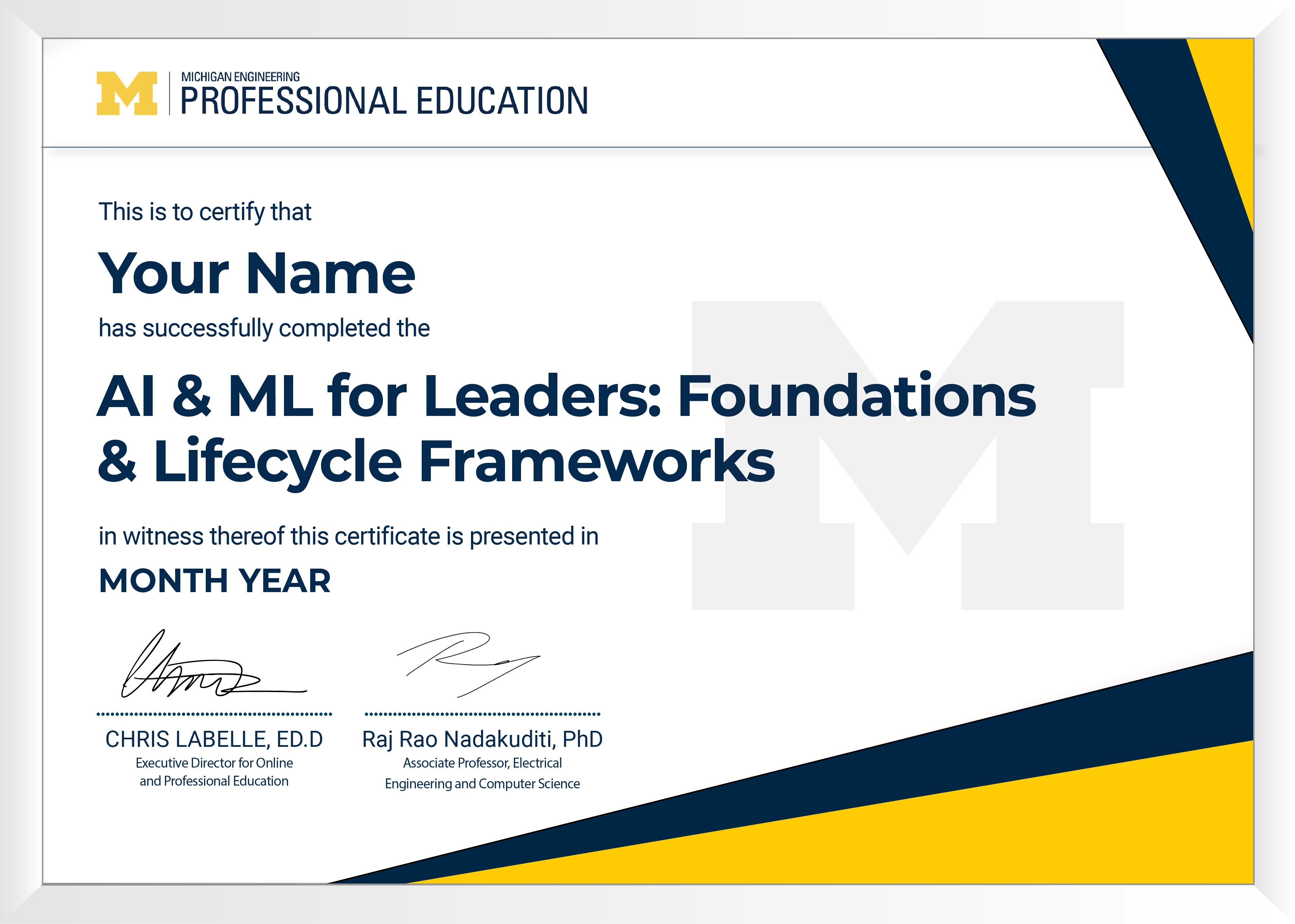
Upon successful completion of the program, you will be awarded a digital certificate by Michigan Engineering Professional Education. The certificate will be a recognition of your achievement in the AI & ML for Leaders: Foundations & Lifecycle Frameworks program.
You will also earn a digital badge, which can be downloaded, shared, and posted on social media sites, including LinkedIn.
Note: Certificates and digital badges are issued in the name used during program registration. Images are for illustrative purposes and may be updated at the discretion of the University of Michigan.
The Michigan Engineering Professional Education Difference
#1
#3
#18
Frequently Asked Questions
Do I need a technical background to succeed in this program?
No. The program is designed for nontechnical and semitechnical leaders. You will learn AI and ML concepts, workflows and terminology without needing prior coding or engineering experience.
Will I learn how to build or code MLmodels?
This is not a coding‑heavy program. Instead, it focuses on understanding how models are designed, trained, evaluated, and deployed, so you can effectively lead, oversee, or partner with ML teams.
What kind of case studies does the program include?
The program uses cross‑industry examples, including Tesla, customer‑support ML systems, AI failures, and bias scenarios. It also takes reference cases from companies like Microsoft and Amazon. These help illustrate real‑world challenges, trade‑offs, and lifecycle decisions.
How interactive is the program?
Learners participate in instructor‑led sessions, guided analysis and practical exercises. Live webinars, discussions and hands‑on walkthroughs ensure strong engagement and applied learning.
What will I be able to do after completing the program?
You will be prepared to define AI problems, evaluate model performance, collaborate with technical teams, oversee ML development cycles, and support AI initiatives with confidence and strategic insight.
Who is this program best suited for?
The program is ideal for business leaders, cross‑functional partners, nontechnical professionals, and project managers working with ML-driven initiatives—especially within engineering and scientific environments.
What certificate will I receive?
Upon successful completion, learners earn a Certificate of Completion from Michigan Engineering Professional Education.
Are the industry examples full case studies?
No. Industry examples (e.g., Microsoft, Amazon) are included as supporting references and recommended readings rather than full, in‑depth case studies.
Are any taxes applicable to this program?
Applicable taxes will be calculated and added at checkout in accordance with country/state regulations.
How does Emeritus support accessibility for learners?
Emeritus is committed to making high-quality education accessible and affordable to individuals, companies, and governments around the world. If you have questions about accessibility or would like to discuss available support options before enrolling, please contact accessibility@emeritus.org. For more information about our accessibility practices, please review our Accessibility Policy here.
Connect with a Program Advisor for a 1:1 Session
Our program advisors have helped executives across the world choose the right program for their career goals. Schedule a one-on-one session to get a deeper understanding of why the AI & ML for Leaders: Foundations & Lifecycle Frameworks is the right fit for you.
Email: learner.success@emeritus.org or Schedule a call with one of our Program Advisors.
Phone: +1 315 623 3923 (U.S.) | +44 1795 904 767 (U.K.) | +52 55966 25370 (LATAM) | +65 3129 8432 (SG)
Flexible payment options available.
Starts On